
Island Retreat
I, John, your brother and fellow participant in the tribulation and kingdom and [h]perseverance in Jesus, was on the island called Patmos because of the word of God and the testimony of Jesus. Revelation 1:9 NASB
Patmos – What do you know about Patmos? I will arrive there in a few days, but what I’ll see now isn’t at all what John saw when he arrived. You see, in Roman times this tiny island was a prison. Only fourteen square miles of rock and sand, it was the perfect place to leave convicts and exiles. No need for guards, the island became the Roman equivalent of Alcatraz. John didn’t arrive in this place for a spiritual retreat. He was left there, among the “undesirables” because, as he says, he proclaimed the gospel of God and the witness of Yeshua. Rome didn’t mind what religion you happened to practice as long as you let everyone else have their own versions. Every god was good. Tolerance was the official policy. But, of course, Jewish believers, especially those who zealously followed the proclaimed Messiah, weren’t so tolerant. So, they were a threat to political stability. Better to ship them off to a place where they had no audience.
Imagine what life was like on Patmos. Yes, there was a small town, dominated by the pagan temple to Artimis. But if the population was filled with criminals and exiles, how much relief do you suppose could be found in community? At best, you would try to avoid contact. At worst, you would have to associate yourself with some group in order to have protection. If you visit Patmos today, you can venture to the cave (now a shrine) where John supposedly received his apocalyptic vision. It comes as no surprise that he lived in a cave far from the small port. It was a matter of survival. Here’s a photo from that spot today.
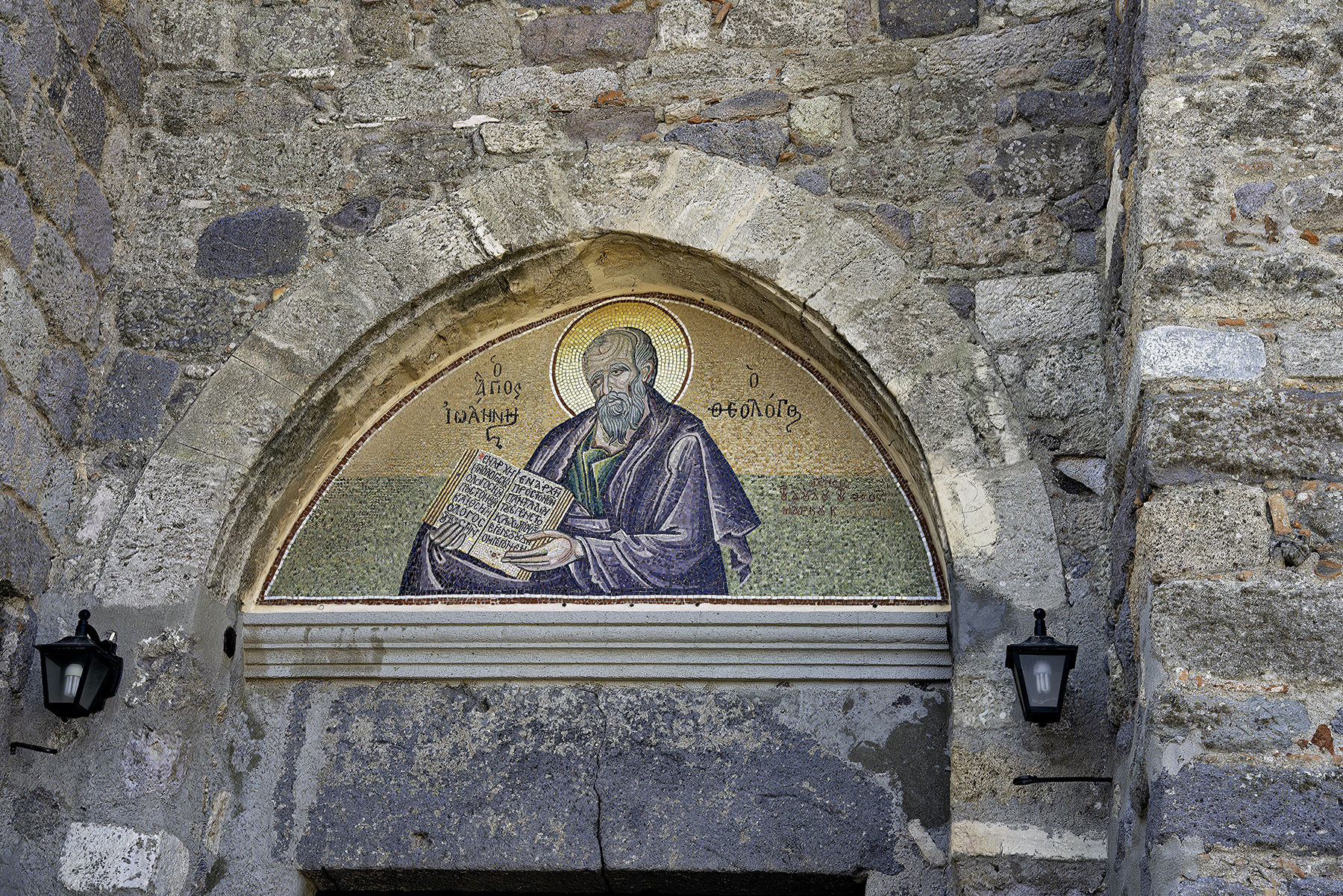
Notice John’s remark about tribulation. He’s a “fellow participant” in thlípsis, a Greek term that describes affliction, harassment, and oppression. We find the expression in the LXX:
The theologically significant figurative use is common in the LXX for various Hebrew terms meaning a. “to distress,” b. “to treat with hostility,” c. “to afflict,” d. “to oppress,” and e. “to harass,” “be hostile to,” and even “destroy,” or, in the case of the noun, a. “trouble,” b. “distress,” c. “oppression,” “tribulation,” etc.[1]
Isn’t it interesting that the Hebrew terms behind this Greek word are the same ones found in Job? Have you ever thought of John’s experience on Patmos in the context of Job’s trials? If you have, perhaps you’ve noticed one significant difference. John has hope. The Messiah provides it. And that makes all the difference.
Topical Index: Patmos, thlípsis, affliction, hope, Revelation 1:9
[1] Kittel, G., Friedrich, G., & Bromiley, G. W. (1985). In Theological Dictionary of the New Testament, Abridged in One Volume (p. 334). W.B. Eerdmans.



Indeed… as those who are “fellow participants” in both the kingdom and the tribulation of Jesus… we can and must also persevere by participation in the hope that he has obtained and substantiates. Thanks be to God for his indescribable gift!
Good to see your comments on Jesus…