
Happy Fear
Fear of the Lord will add days, but the years of the wicked will be shortened. Proverbs 10:27 Chabad
Fear – The fundamental insight of biblical wisdom is fear of the Lord. That might sound harsh. We’re used to the Western Christian idea of the love of God. Fear seems like something ominous, foreboding, perhaps even judgmental. We would rather have the benevolent Father than the cosmic Judge. But it’s difficult to deny the fact that “fear of the Lord” dominates the Hebrew Scriptures. Our issue is not with the text but rather with the cultural paradigm of the vocabulary. For that, we need a lesson in biblical fear.
Let’s start with this verse.
יִרְאַ֣ת יְ֖הוָה תּוֹסִ֣יף יָמִ֑ים וּשְׁנ֖וֹת רְשָׁעִ֣ים תִּקְצֹֽרְנָה
The first word, yir’ăt’, leads us directly to hope. How so? Because according to this verse, fear of the Lord extends life. Notice that the opposite is true for the wicked. Their lives are shortened. The comparison shows us that “fear” (yārēʾ) is not the antonym of “confident” but rather the opposite of “wicked” (rāšaʿ). That means that the biblical equivalent of “fear the Lord” is righteousness, not terror, and this means we have to completely adjust our usual reaction to a word like “fear.”
Perhaps we should start by asking, “Why should we be afraid of God?” The usual answer is about punishment. Like this:
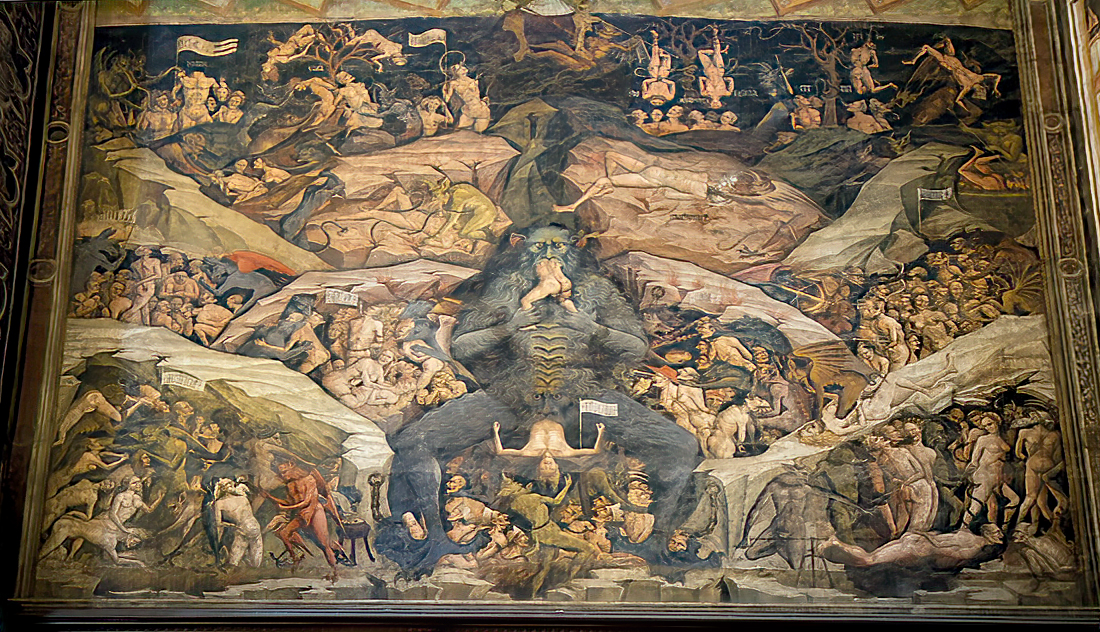
We might not have grown up surrounded by these images (found in many Catholic churches in Europe), but we were often told that “God sees everything and will hold you accountable.” Forgiveness, salvation, and conversion were escape routes. “Where will you go when you die?” was designed to scare you into the Kingdom. Of course, as Western culture eradicated its spiritual foundations, the idea of Hell and eternal punishment no longer held the attention of the populace. If there’s no Heaven or Hell, why worry?
That’s a reasonable question to ask of the audience of the Tanakh. The Hebrew Scriptures have very little if anything to say about an afterlife. The idea of reward and punishment after death crept into religious thinking during Hellenism. So, if you live in a culture where the end is the end, why fear God? Now we see why our image of a God of retributive judgment isn’t really part of the Hebrew idea of fear. Fearing God in Hebrew Scriptures is not a scare tactic. It’s an expression of a long and good life, exactly the opposite of what Christianity portrayed.
Read Proverbs 10:27 again. The focus is entirely on this life, this world, this timeframe. The “fear” of God is a synonym for “living according to His instructions.” And that way of living, according to the text, increases one’s years. Consider for a moment what that means in terms of ordinary existence. Torah covers diet, exercise, relationships, community obligations, truthfulness, family, business practices, production, government, and religious rituals. Torah is about what it takes to live peacefully, without stress, in harmony with your fellow men and with God. How could that not add years to your life? In this sense, fear of the Lord is the very best thing that can happen. Yes, of course, God sees it all, but the more my “all” is aligned with His intentions, the less anxiety, stress, and confusion I have. Life becomes a blessed journey, not an anxious hope for something after I die. What more could one ask?
Topical Index: fear, Hell, punishment, Torah, stress, Proverbs 10:27



“…the biblical equivalent of ‘fear the Lord’ is righteousness, not terror… Fearing God in Hebrew Scriptures is not a scare tactic. The ‘fear’ of God is a synonym for ‘living according to His instructions’… It’s an expression of a long and good life…fear of the Lord is the very best thing that can happen… Life becomes a blessed journey, not an anxious hope for something after I die…” Emet! …amen.
“…may the wise hear and increase learning,
and the one who understands gain direction…
Fear of Yahweh is the beginning of understanding;
wisdom and instruction, fools despise.” (Proverbs 1:5,7)