
Plant Life
Purify me with hyssop, and I will be clean; cleanse me, and I will be whiter than snow. Psalm 51:7 NASB
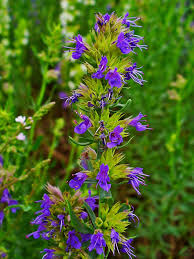
Hyssop – Why does David choose this plant, a bitter aromatic member of the mint family? The answer is in Exodus and Numbers. Hyssop has a history.
The importance of hyssop stems from the Exodus. God told Moses to have each Israelite family slay a lamb, dip a bunch of hyssop in the blood in the basin and then smear some of the blood on the sides and top of the doorframe (Ex 12:22). When the Angel of the Lord passed by and saw the blood, he spared the firstborn son in that home. Thus, the hyssop functioned as a brush to apply the blood.[1]
Perhaps more importantly for David, the application of the blood with the hyssop spared the first-born child, and that, of course, is the top of David’s mind.
Secondly, hyssop plays a role in the purification ritual. Numbers 19 describes the ritual of the red heifer which will remove the stain of sin on the people. Verse 20 is particularly important: “But the person who is unclean and does not purify himself, that person shall be cut off from the midst of the assembly . . .” Wolf comments: “When David in repentance cried out to God, ‘Purify me with hyssop, and I shall be clean’ (Ps 51:7 [H 9]), he referred to the laws of Num 19. He knew that if he were not cleansed, he would be cut off from his people.”[2]
Thus, two crucial references are tied to David’s choice: the potential sparing of his child and his own restoration to God’s people. The results were not what David wanted. There was a price to pay. A lesson to learn. A hard lesson. For reasons known only to God, hyssop is attached to death. “Purify me with hyssop” isn’t a plea for soft-grace forgiveness. Rather, it’s sin exfoliation. Fortunately, sin can be scrubbed off. It doesn’t grow from within. It doesn’t require organ transplants. It requires stain removal, and sometimes the means of removal is the death of something else. It’s a lesson in pain, not to be easily forgotten (although we do tend to forget, don’t we?). Such a lovely looking plant. Such a consequential message.
Topical Index: hyssop, Exodus 12:22, Numbers 19:20, Psalm 51:7
[1] Wolf, H. (1999). 55 אֵזוֹב. In R. L. Harris, G. L. Archer Jr., & B. K. Waltke (Eds.), Theological Wordbook of the Old Testament (electronic ed., p. 27). Moody Press.
[2] Ibid.



David knew the score because the prophet Nathan filled him in, “thou art the man!”, but who today would equate the death of their infant child, or any other tragedy to a loved one for that matter, to their own sin. God said he had “put away” David’s sin, so he wouldn’t die. NEVERTHELESS, the child will die. This is over my pay grade, I don’t get it. I suppose it must harken back to Exodus 34:7, “…forgiving iniquity, transgressions, and sin, yet by no means clearing (exempting from punishment) (the guilty). The English versions add “the guilty” as if it’s implied, and maybe it is, but I read this as, paraphrased, “I forgive your sins, but sins have consequences which must be worked out no matter how many generations it takes. Everybody suffers for it.
It almost makes one not want to sin anymore 😕.
“Almost”! 🙂