
What Time Is It?
And it was when the king of Ai saw, they hastened and rose up early, and the men of the city went out against Israel to battle, he and all his people, at a time appointed, before the plain; but he did not know that there was an ambush against him behind the city. Joshua 8:14 Chabad
A time appointed – Notice the difference between the Jewish to English translation of Chabad and the Hebrew translation to English in the NASB:
And it came about, when the king of Ai saw them, that the men of the city hurried and got up early, and went out to meet Israel in battle, he and all his people at the appointed place before the desert plain. But he did not know that there was an ambush against him behind the city. NASB
Do you see that Chabad translates môʿēd as “appointed time” but the NASB translates it as “appointed place”? Lewis comments in TWOT:
This masculine noun occurs 223 times. It frequently designates a determined time or place without regard to the purpose of the designation. It may be the time for the birth of a child (Gen 17:21; 18:14; 21:2), the coming of a plague (Ex 9:5), the season of a bird’s migration (Jer 8:7), an appointed time (I Sam 13:8; 20:35), the time for which a vision is intended (Hab 2:3), the times of the end (Dan 8:19), or the time for the festivals (Lev 23:2) and solemnities (Deut 31:10).[1]
Chabad follows Jewish custom by treating the word as an appointed time because it is the same word used for the sequence of religious feasts and festivals which are not topological but rather temporal. However, by following the usual translation, this verse raises an unanswered question; a question that is ignored when the word is translated as “place.” The question is simple: What time is this? Jewish commentators offer three different answers: 1) it is a time set by Joshua, 2) it is the same time as the previous battle, and 3) it is a time set by the King of Ai. Take your pick. The text gives us no clue at all what time this is.
Does the grammar help? NASB treats the word as if it had a definite article (the appointed place), while Chabad reads the phrase with an indefinite article (a time appointed). The Hebrew does not have a definite article (לַמּוֹעֵ֖ד). It seems that the English translators require a definite article in order to make sense of the verse. In fact, in the Logos software version of the Hebrew text, the explanation adds the definite article (see below):
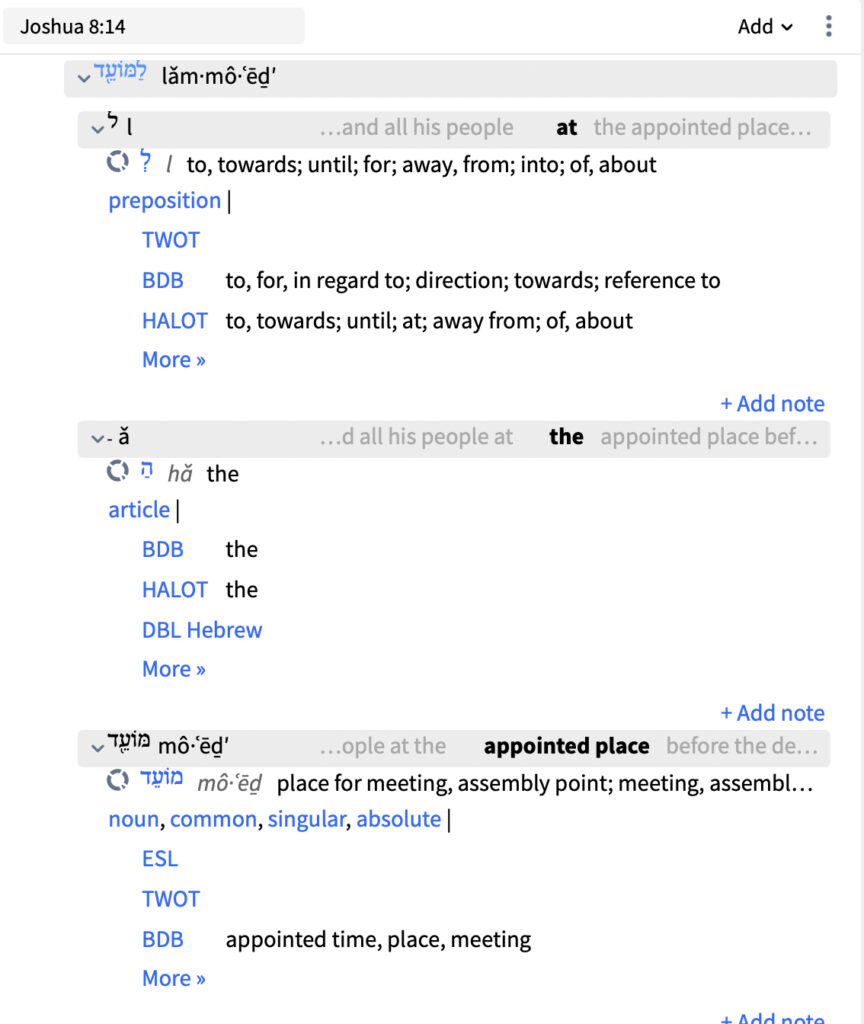
What would you rather live with? A deliberately altered text or a text that doesn’t answer an obvious question?
Topical Index: môʿēd, appointed time, appointed place, Joshua 8:14
[1] Lewis, J. P. (1999). 878 יָעַד. In R. L. Harris, G. L. Archer Jr., & B. K. Waltke (Eds.), Theological Wordbook of the Old Testament (electronic ed., p. 388). Moody Press.



Recognizing that in our mode of existence or being there is much of reality that can only be expressed in a representative way, it stands to reason that a deliberately altered text or a text that doesn’t answer an obvious question could be utilized to convey such reality.
The key to discerning spiritual understanding is that spiritual realities can only be conveyed by spiritual means to those who are spiritual— who share the mind of Yahweh God’s own chosen Messiah.
Disclosure of a transcendent reality is a tenuous sort of revelation.
“What would you rather live with? A deliberately altered text or a text that doesn’t answer an obvious question?”
Good question Skip. I’ve taken a few minutes to think about this and I’ve decided that I would rather have a text that doesn’t answer an obvious question. There are too many text in translations that we discovered that the text has been altered or rearranged in order. Greek/ Western thinking needs order and a constant answer with no gray or uncertainties. The writers of scripture were Hebrew and Eastern thinkers. The language and thinking are fluid and adaptable. We on the west cannot identify or understand this so we make changes so it makes sense to us. Where is the discourse?
Is it any wonder why we cannot communicate well and come to lasting agreements in the Middle East. We believe everyone should think and be like us.
Well put, Bill. (Particularly since spirit/[the Spirit] is the mediator of discourse.)
Thanks Richard. Since starting studies with Skip since 2010 and Rabbi Fohrman from Aleph Beta a couple years earlier I have gotten some understanding of Hebrew writings and Eastern thinking. And it has since amazed me, that with my simple understanding of the difference between Western thinking, that most professional politicians don’t have a clue that there is a difference and continue to try to negotiate with their hands tied.